
Convert units and B.E./C.E. years with KrobClick and verify results
How many square meters are in one rai? What is 30 degrees Celsius in Fahrenheit? How different are MB and MiB? One tool covers several categories, but first choose the correct units and meaning of the figures.

Choose the category before the units
Unit and year converter supports length, weight, temperature, area, volume, speed, data size, and B.E./C.E. years. Choose the correct category: square meters measure area, while meters measure length.
Cross-category conversions may need additional information: liters-to-kilograms conversion requires density. The tool therefore keeps categories separate. The category labeled “Weight” uses mass units such as kilograms and grams, not force units such as newtons.
Fill in the values and understand the unit switching buttons.
- Open the tool and select “Conversion category”
- Fill in “original value” with real numbers, do not leave blank.
- Choose From Unit and To Unit, then read the result with both unit names
- When copying a result, record its units too: the copy button includes only the displayed value.
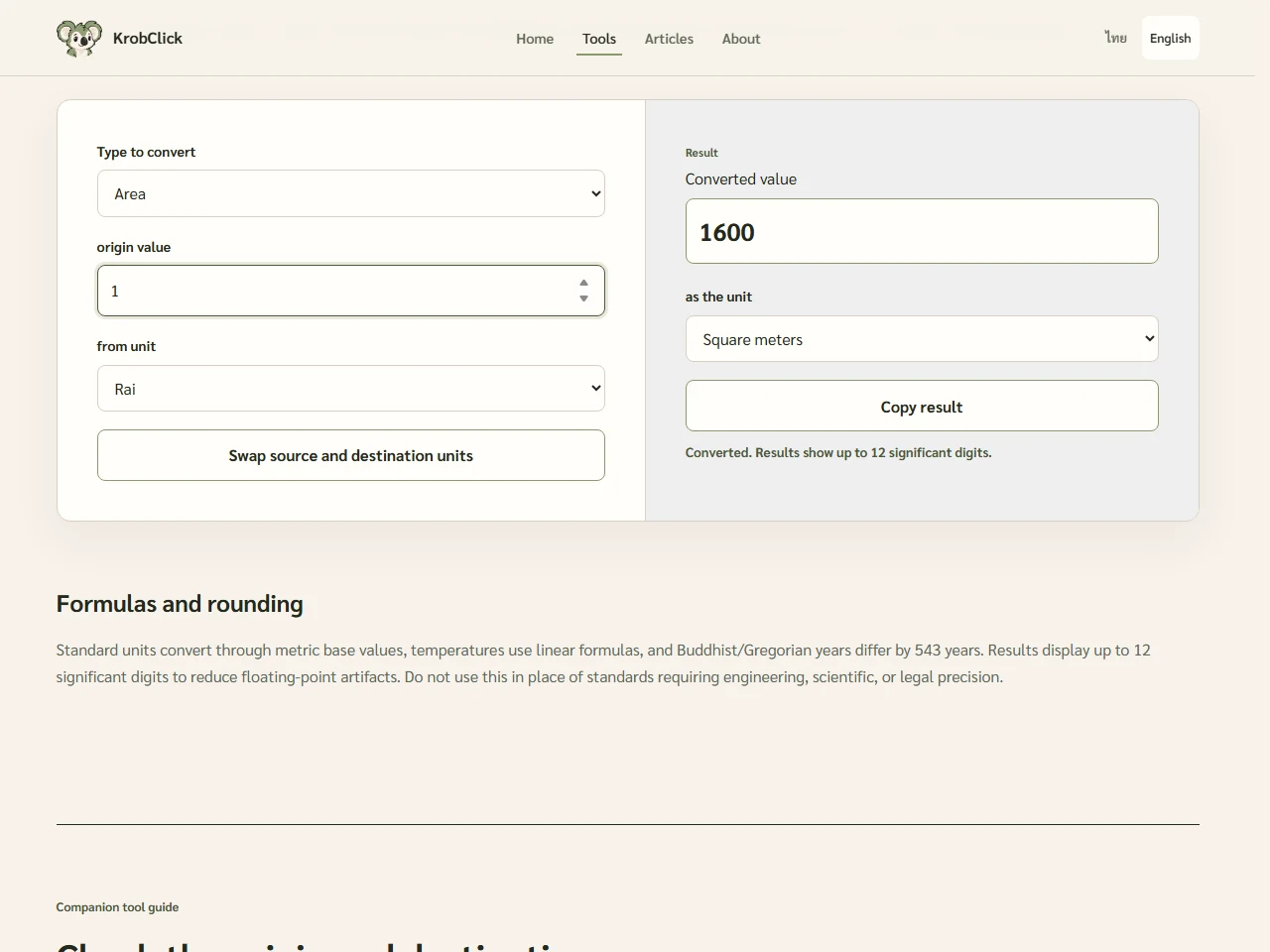
Swapping units leaves the original numeric input unchanged. For 1 rai → 1,600 m², swapping without changing the input calculates 1 m² → 0.000625 rai. To check the original result in reverse, also change the input to 1600.
Examples that can be used to check answers
| Task | The result you should get | Verifiable reasoning |
|---|---|---|
| 1 rai → square meters | 1,600 square meters | The tool defines 1 rai = 4 ngan and 1 ngan = 400 square meters. |
| 100 square wah → ngan | 1 ngan | 1 square wa = 4 square meters |
| 30 °C → °F | 86 °F | 30 × 9 ÷ 5 + 32 |
| 2569 B.E. → A.D. | 2026 C.E. | 2569 − 543 |
| 1 MB → bytes | 1,000,000 bytes | Uses base ten |
| 1 MiB → bytes | 1,048,576 bytes | Use 1,024 × 1,024 |
Temperature conversion is more than multiplication. Converting °C to °F also adds 32; multiplying a thermometer reading by 1.8 is insufficient. A temperature of 10 °C differs from a 10 °C temperature increase. This page converts temperature readings, not differences directly.
Similar names may have different definitions.
Data sizes use decimal and binary bases, so MB and MiB differ. For a 2 MB upload limit, check the destination's definition and leave headroom. Changing the file extension or unit label does not meet the limit. Read Prepare a PDF to meet the size limit when submitting documents.
The tool defines a cup as a 250-milliliter metric cup, a teaspoon as 5 milliliters, a tablespoon as 15 milliliters, and a gallon as a US gallon. Do not apply these to other cup or gallon definitions without checking the source. Ordinary eating spoons are not standard measuring equipment.
The conversion factors and formulas were checked against KrobClick’s code. The sources link to the public tool so you can test the examples. The BIPM is the primary SI reference, not an endorsement of every household unit or the Thai calendar rules chosen by this tool
Be careful when rounding values and historical years.
Non-integer results are displayed with up to 12 significant digits, which differs from 12 decimal places. The number of digits shown does not guarantee accuracy: it still depends on the input, and some conversion factors are stored with finite decimal precision. The results are therefore better suited to general use than to certification work.
B.E./C.E. conversion uses a 543-year difference and accepts whole years only. The year category starts with 2569 B.E.; it does not fetch the current calendar year each time. This formula does not handle dates, ages, or historical New Year changes. For old documents, verify the original calendar and date range separately.
If the answer appears to be wrong, check the category, unit direction, and unit definition before pressing recalculate. The tool works in the browser without sending numbers to external processing. However, it should not be used as a substitute for engineering, scientific, medical, or legal documents that require specific examination.
Sources
KrobClick tool and code reviewed October 21, 2026 using nonsensitive demo text and documents. Screenshots show local development. Scope and limits may change; inspect output files or text before use.