
How inflation affects savings
An intact 100,000-baht savings balance does not mean it will buy the same things in ten years. Using identical assumptions, we calculate two questions: how much money will be needed, and what purchasing power the same amount will have relative to today.
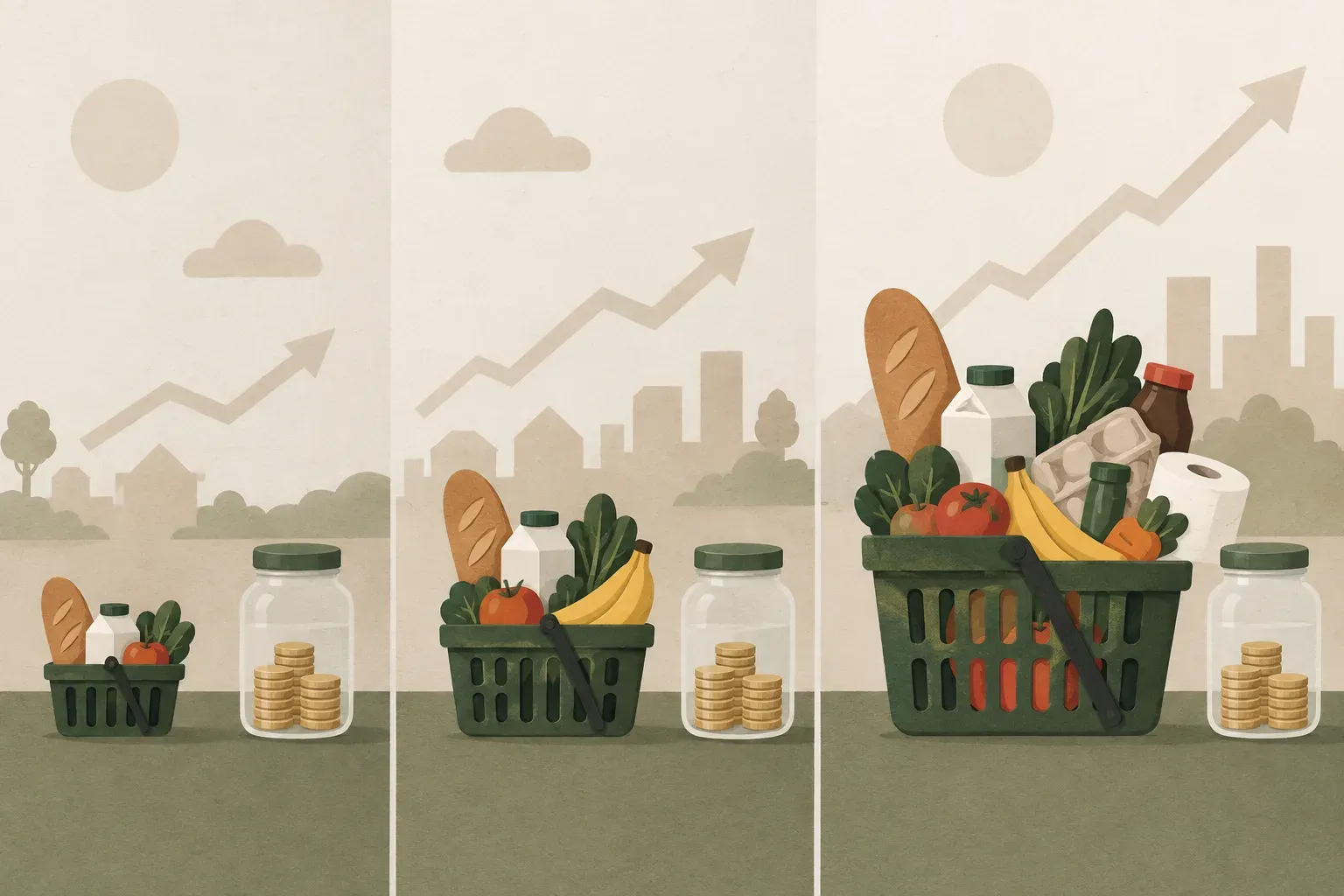
Inflation affects what money buys; it does not directly subtract from your account balance
Inflation is a rise in the general price level of goods and services. If income or savings fail to keep pace, the same money buys less. The Bank of Thailand explains the link between inflation and the cost of living. Prices do not rise equally for every product, nor does every shop raise prices simultaneously
Headline inflation is calculated from a basket of goods and services, so it may differ from the costs an individual household faces. A family spending a greater share on rent, healthcare, or education than the basket may experience a different change in living costs. Review actual spending too, and do not infer overall inflation from one item’s price.
Calculate future spending needs and the purchasing power of your money
If buying a basket of goods costs P today, and prices are assumed to rise at annual rate f for t years, the future amount needed is P × (1 + f)^t A future amount A, expressed in today's purchasing power, is A ÷ (1 + f)^t One formula multiplies and the other divides because they ask questions in opposite directions
Assume 100,000 baht and constant annual inflation of 3% for ten years, excluding returns and costs. The 3% figure is an educational assumption, not current inflation or a forecast. This article rounds only displayed amounts to two decimal places.
| Question | Calculation | Approximate answer |
|---|---|---|
| How much money do you need in ten years to buy something equivalent to 100,000 baht today? | 100,000 × 1.03^10 | 134,391.64 Baht |
| If ten years from now there are still 100,000 baht, how much will you be able to buy compared to today? | 100,000 ÷ 1.03^10 | 74,409.39 Baht |
The two answers use money from different points in time as their bases, so they are compatible and should not simply be subtracted. The first is the total future amount needed to buy the same basket; the second is today’s equivalent purchasing power of a balance that does not grow. In reports or plans, label amounts as “future baht” or “baht in today’s value.”
Positive interest can still mean a negative real return
The one-year real return formula is (1 + nominal return) ÷ (1 + inflation) − 1 using decimal rates. If money grows 2% while prices rise 3%, the result is 1.02 ÷ 1.03 − 1 ≈ −0.97%. The balance grows, but its purchasing power falls; the account is not directly debited by 0.97%.
Calculating 2% − 3% = −1% is a close approximation at low rates, not an identity in every case. If 2% growth is before tax or fees, use the appropriate net return for the question.
Use the calculator to distinguish amounts from purchasing power
- Open Inflation and purchasing power calculator Enter the amount and planning horizon in years
- Choose inflation assumptions to compare instead of treating one value as certain over a long period
- Check whether each result means the future amount needed or its equivalent value today, then verify units before reusing it.
- If including returns, separate nominal returns from real returns after inflation and record whether taxes are included
The tool assumes constant growth rather than retrieving actual monthly inflation or forecasting household prices. For tuition or healthcare goals, also consult relevant expense data. Broad inflation does not cover every risk of a specific expense.
Reserves still serve a purpose even if purchasing power declines
A negative real return does not mean all cash should be moved into risky investments. Money for near-term expenses and emergencies provides liquidity. Access to that money and preserving purchasing power over the long term are different goals. Consider the time horizon and your capacity to absorb losses.
You can use Emergency fund calculator to plan accessible reserves separately from longer-term goals. This article gives no universal allocation or guaranteed way to beat inflation.
Review the plan based on actual expenses and assumptions in many cases.
Hypothetical example: essential spending of 20,000 baht per month gives a six-month reserve target of 120,000 baht. If all those expenses rise 3%, monthly spending becomes 20,600 baht and the target becomes 123,600 baht, leaving a 3,600-baht gap if reserves are unchanged. This assumes equal expense growth and the same six-month target. Update a real plan using actual expenses rather than automatically applying headline inflation.
Record major expense categories and review them when rent, family obligations, or income change. Assess what a projected balance could buy, and use the same purchasing-power base when comparing years. Read Compound interest to examine money growth alongside rising prices
For long-term plans, calculate low- and high-inflation scenarios and compare the target amounts. Use the results to allow for uncertainty, without treating them as forecasts. As new information becomes available, update the assumptions and record why, so each review reflects the information available at that time.
Sources
Sources reviewed October 11, 2026. Figures are hypothetical educational examples, not current rates or personalized financial, investment, legal, or tax advice.