
Claude in Hermes: API, OAuth, and DirectSDK Quotas
Hermes Agent already supports Claude, but this can mean separate API billing, Claude Max with Extra Usage, or Pro/Max access through an experimental plugin. Accounts, quotas, and components differ. This article distinguishes the paths to match what you have.

Claude in Hermes already exists, but there is not only one path.
Short answer: Hermes Agent already supports Claude through the provider anthropic built into the system, using an API key or Anthropic OAuth. Claude is also available through intermediary providers, while Claude Subscription DirectSDK is another plugin route that calls Claude Code already logged in to a Pro or Max account. DirectSDK thus adds a way for Hermes to use Claude entitlements and quotas alongside its existing Claude access routes.
Anthropic OAuth and DirectSDK both use Claude accounts but differ in connection methods and quota use, according to Hermes provider documentation Hermes' built-in Anthropic OAuth path works with Claude Max and Extra Usage, consuming those extra credits rather than Max's basic quota. Pro cannot use this path, while List of plug-ins in the catalog states that DirectSDK routes requests through Claude Code CLI using the Agent SDK allowance of its signed-in Pro/Max account.
Compare costs, quotas, and setup for API, OAuth, and DirectSDK
| Path | Identification | What is consumed or billed | Status in Hermes | Who it suits |
|---|---|---|---|---|
| Anthropic API | ANTHROPIC_API_KEY | Usage-based API fees are separate from Claude membership fees. | Built-in Provider | Work that requires a direct API path and clear expense accounting |
| Anthropic OAuth | Sign in with hermes model or use Claude Code credentials | According to Hermes documentation, Claude Max Extra Usage does not consume the base Max quota | Built-in Provider | Max users who have opened and added Extra Usage |
| Claude Subscription DirectSDK | Claude Code CLI at claude auth login | Agent SDK allowance of Pro/Max; Extra Usage also depends on account settings. | Official Nous Research plugin, still experimental | Pro/Max users who accept an experimental plugin's limits |
The term “Official” in the table refers to plug-ins that Nous Research maintains and distributes through the Hermes official catalog. It does not confirm that Anthropic has endorsed this plug-in as a product, however. Claude Help Center updated 7 October 2026 states that the Agent SDK, claude -p and external apps could still use subscription limits as of the review date
The Claude Help Center checked October 29, 2026 adds that Max and Team include monthly API credits when using an API key from the Console organization linked to the plan. Agent SDK or claude -p signed in with the plan still uses subscription limits. Do not assume every API key is outside plan benefits: check the issuing organization, remaining credits, and actual billing separately from Hermes’ OAuth route.
Other ways to use Claude with Hermes: identify the paying account and applicable quota
In addition to the three routes that connect to the Anthropic account above, Hermes also has access to Claude through other providers. Having Claude available does not mean using the Claude Pro/Max quota you are already paying for. These paths use the selected provider's account and terms, with Hermes provider documentation The connection is specified as follows.
| channel | Account and how to connect | Where is quota consumed or billing charged? | What should I check before using? |
|---|---|---|---|
| OpenRouter | OpenRouter accounts are connected with an API key or OAuth as supported by Hermes. | OpenRouter credits and usage charges | Claude model, price and destination provider selected by route |
| Nous Portal | Nous account login via OAuth hermes model | Nous plan access and limits | Claude version available for account use and remaining usage of the package |
| GitHub Copilot | GitHub account with Copilot permissions, select provider copilot In Hermes | Copilot entitlements and usage accounting by plan | List of models that the account can actually call Including organizational policies and usage limitations. |
| AWS Bedrock | AWS account and permissions to run models using provider bedrock with AWS credentials | AWS account charges based on model and usage model | Region, IAM permissions, model access, and AWS quotas |
The channels in the table have supporting documents. However, there are other services available and the Claude version that can be called may vary by account. GitHub separates model availability by package and channel. Therefore, you should not use just seeing the name Claude in Copilot Chat as evidence that Hermes can call that model. For OpenRouter, check both Credit calculation and conditions of the destination service provider Before comparing the price to the API directly
Hypothetical example: You already have Claude Pro and Copilot. If you choose copilot In Hermes, that work uses Copilot entitlements. A local Claude Pro login does not transfer its quota to this provider. Likewise, OpenRouter or Bedrock needs a separate billing account with that service.
KrobClick suggests starting with an existing account where the desired Claude model is actually available. For multiple providers, consider OpenRouter or Nous Portal. Copilot users should check account entitlements before adding subscriptions. AWS teams can compare Bedrock with existing permissions and budgets. For Claude Pro/Max access through Claude Code specifically, return to DirectSDK and the plugin limitations below.
Before continuous use, turn on hermes model Choose a provider and a Claude model available to your account, test one short task, and compare that service's usage with /usage in Hermes, also checking which providers auxiliary and fallback use. Hermes estimates alone do not confirm billed amounts. Review every service's data policy before sending sensitive information through it.
DirectSDK provides subscription access while Hermes retains control
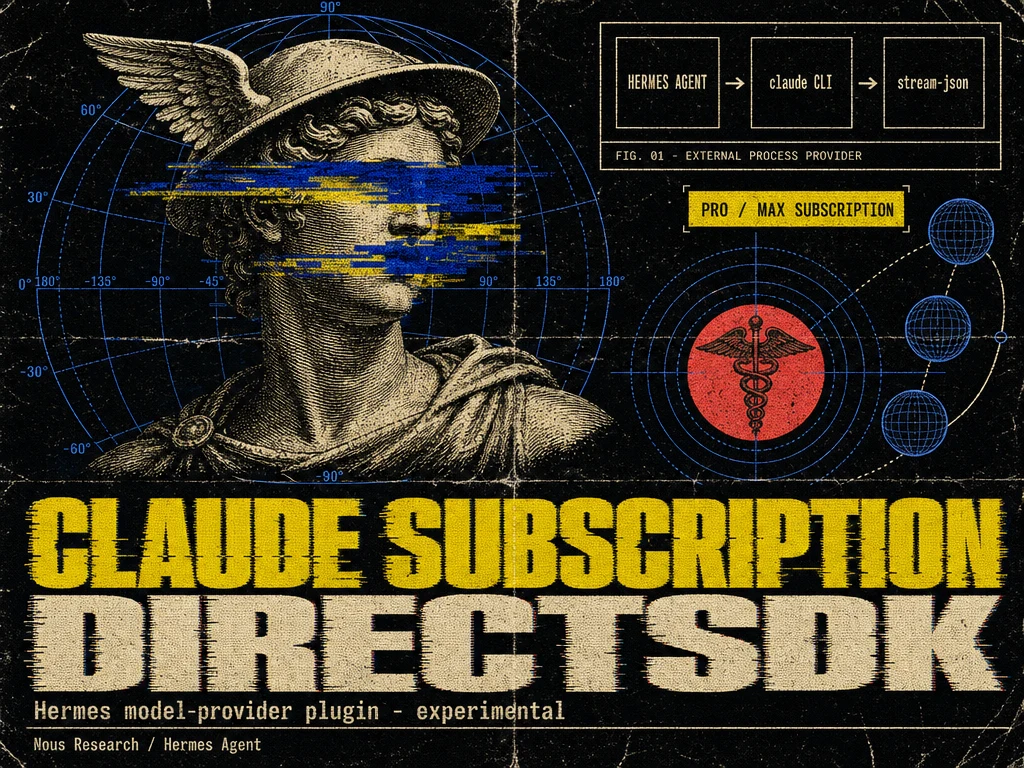
The name DirectSDK might lead you to think that Hermes has moved all of its work to the Claude Agent SDK, but Plugin README explains that the implementation launches the official Claude Code executable and communicates using stream-json directly, without separately installing the Python Agent SDK package
The plugin has no credentials of its own. Claude Code CLI handles login, session renewal, and account entitlements; DirectSDK forwards Hermes requests and returns results. This route does not silently fall back to API keys if subscription access fails, exposing login/quota issues rather than unintended API charges.
Hermes also controls the agent loop, while Claude Code is the model's gateway.
Whether Claude is accessed through Anthropic API or DirectSDK, Hermes handles the main work: message sequencing, tools, approvals, sessions, skills, and context compression. For DirectSDK, the plugin disables Claude Code's native tools and skills and supplies Hermes' tools instead, preventing two competing agent loops.
Hermes memory and skills continue working as before. Switching from Anthropic API to DirectSDK changes model access and quota accounting; it does not move Hermes memory or configuration into Claude Code. To understand these components first, read What is Hermes Agent? can be extended
Install DirectSDK and verify the path with your account and usage.
The manifest version 0.3.3 pinned by the Hermes catalog requires Hermes 0.21.4 or later with Python 3.10+ and the official Claude Code CLI. The steps from the current README are:
npm install -g @anthropic-ai/claude-code
claude auth login
hermes plugins install claude-subscription-directsdk
hermes model
Open the model settings with the last command, then choose Claude Subscription DirectSDK (Experimental) and a model available to your account. Once you can select a model, try one short task before using the gateway, cron, or a long workflow. Reaching model selection shows that Hermes found the CLI and account. Test the model, long-context work, and fallback with your own workload.
- Verify account: Run this command and confirm that you are signed in to the intended Pro/Max account.
claude auth status - Confirm version: Check the CLI version with this command and compare it with the README’s minimum for the chosen model.
claude --version - Confirm quota: After the trial, check
/usagein Hermes alongside Claude usage. A list-price estimate in logs does not prove an actual charge. - Check Extra Usage: Turn off Extra Usage on your account if you don't need extra charges. Because final rights and charges remain with the Anthropic account.
Do not copy tokens from credential files into configuration. The plugin leaves login ownership with Claude Code; its README says DirectSDK does not open, copy, refresh, or print credential files. For multiple accounts across profiles, configure claude_config_dir of each profile instead of switching files by hand
DirectSDK differs from the Codex subscription path in the location of the connector.
Hermes has OpenAI Codex as a built-in provider, allowing users to log in using device code or browser flow, and Hermes stores credentials in its own auth store, as well as retrieving credentials from the Codex CLI when available. There is no need to install the Codex CLI for the main path. DirectSDK, on the other hand, is a separate plugin and must call the locally installed Claude Code CLI each time it is used.
| Issue | Claude Subscription DirectSDK | OpenAI Codex provider |
|---|---|---|
| Position in Hermes | Official plugin separate | Built-in Provider |
| Required external programs | Requires Claude Code CLI. | The primary path does not require Codex CLI |
| Agent loop owner | Hermes | Hermes |
| Status | Experimental | First-class provider |
| Quota meaning | The plugin documents the Pro/Max Agent SDK allowance | Hermes documentation does not fully detail plan tiers and Codex quota accounting |
Both routes leave memory, tools, and approvals under Hermes. Claude Code or Codex CLI does not take over those responsibilities. Compare the model version together with the provider Hermes uses, since the Claude or GPT name alone does not describe the full workflow.
What the DirectSDK tests establish
The README reports testing with tool calls, streaming, resume, denial, steering, and cancellation, but describes it as a review build, not saying it is equivalent to a normal provider in all cases. The replay mechanism and some of the data sent through Claude Code are subject to interface changes with versions. It is important to read the latest plug-in status before updating Claude Code or Hermes on a production system.
- Long context and cache: The plugin must create a conversation history for Claude Code with each request, so replay and prompt cache behavior is more complicated than a straight API path.
- Upstream errors: Incomplete streams or HTTP errors remain failures; there is no automatic fallback to an API key
- auxiliary and fallback: Hermes also controls these paths. DirectSDK does not automatically switch every compression, vision, subagent, or fallback to subscription. You must check your configuration separately.
- telemetry: The setting
claude_code_telemetryis enabled by default, allowing Claude Code to send usage telemetry and receive feature flags. Disabling it reduces traffic but may narrow the model list. - Plugin security: Official tier means inclusion in Nous Research's catalog. Still check version, commit, and source before updates to important systems.
Choose a Claude connection by account, quota, and cost
Choose Anthropic API When you want agent spending separate from Claude membership, need a built-in provider route, or already track an API budget Select Anthropic OAuth When using Claude Max with Extra Usage and accepting that Hermes consumes extra usage rather than the basic quota under current documentation
Choose DirectSDK for a trial If you already have Claude Pro/Max, want Agent SDK allowance through Claude Code, and can check versions, quotas, and Experimental plugin limits yourself, start with reversible tasks. Compare stability, quota consumption, and logs for the same task on the API path.
Before deciding, answer four questions: Is the Claude account Pro or Max? Is Extra Usage enabled? Can the task accept an experimental provider? Which providers handle auxiliary/fallback? Use these answers to choose configuration and check costs and limits for that route.
Sources
- Nous Research: LLM and Model Providers
- Nous Research: Claude Subscription DirectSDK plugin catalog entry
- Nous Research: Claude Subscription DirectSDK README at catalog-pinned commit
- Nous Research: Claude Subscription DirectSDK plugin manifest v0.3.3
- Anthropic: Use the Claude Agent SDK with your Claude plan
- Nous Research: Nous Portal
- OpenRouter: Anthropic models
- OpenRouter: Frequently Asked Questions
- GitHub: Supported AI models in GitHub Copilot
- Anthropic: Access Claude in Amazon Bedrock
Hermes documentation, catalog, plugin 0.3.3 manifest, Nous Portal, OpenRouter, Copilot, and Claude Help Center reviewed October 19, 2026. Plans, quotas, Extra Usage, models, and plugin behavior may change. Check usage and installed-version documentation before costly or important work.