
Hermes Agent: Memory, Skills, and the Agent Runtime
Hermes Agent addresses tasks conventional chatbots often struggle with: cross-session context, multiple tools, ongoing work, and reuse of lessons. This article distinguishes actual capabilities, mechanisms behind self-improvement, and limitations before practical use.
What is Hermes Agent and how is it different from a chatbot?
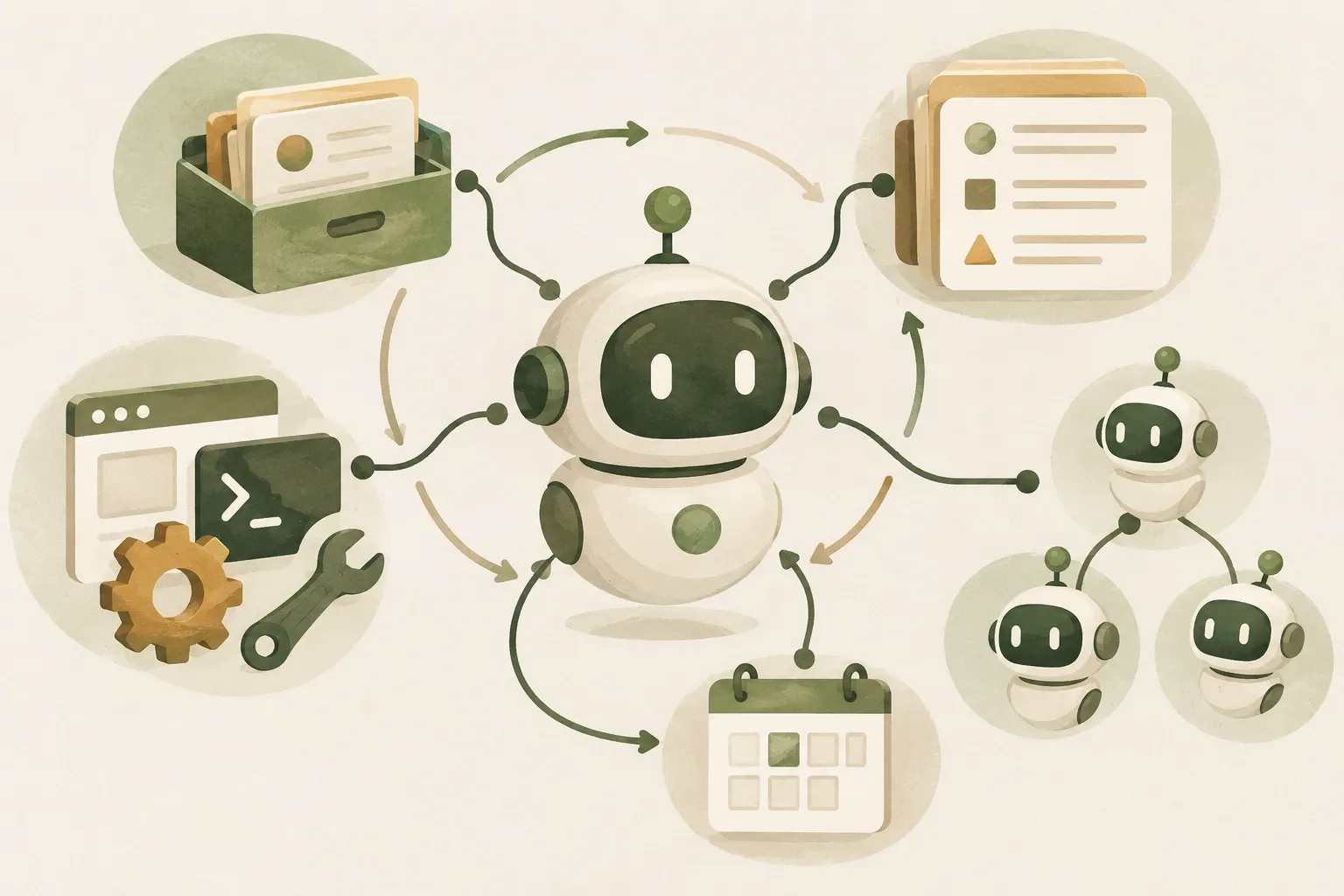
Hermes Agent is Nous Research's open-source AI agent project, positioned as an “agent that grows with users.” Its focus goes beyond a new language model to building agent runtime which surrounds a language model with memory, tools, skills, sessions, subagent delegation, and scheduled work
If you look at it in the simplest way. The language model is “The brain that thinks in each cycle,” while Hermes Agent is the “operating system” that organizes what context the model sees. Which tool to run? What lessons do you keep? And how to forward work to other processes? This difference is important because self-improving of Hermes does not mean that the main model is retrained with new weight after every event. But it means that the system can adjust memory, skills and work context to improve future work or better match user preferences
This article retains release v0.21.3, dated September 14, 2026, as its earlier reference point, not as a claim that it is the latest version when you install. Main-branch documentation may describe capabilities differing from your installed package. Match your version and release notes before relying on documented commands or defaults.
Hermes centers on an agent loop, not a single model
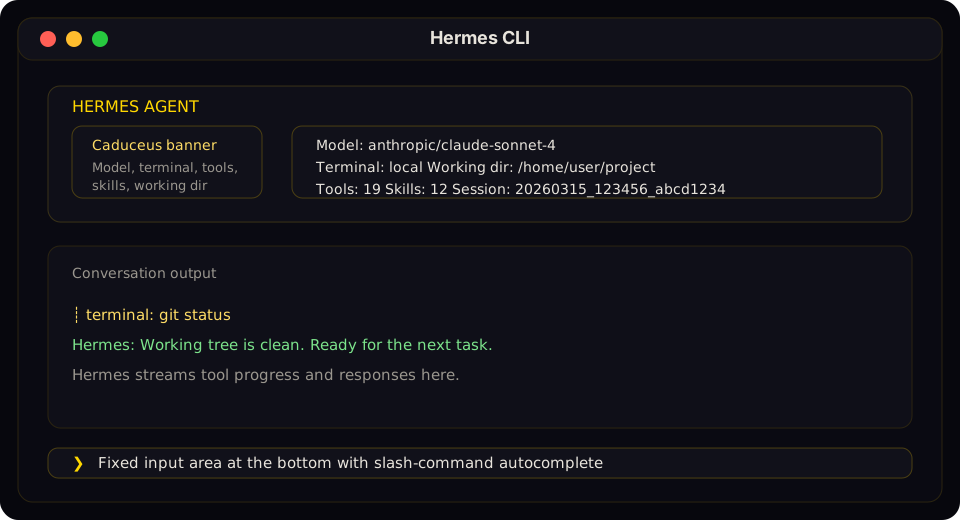
At the heart of the system is the agent loop: it receives user messages, assembles the system prompt, selects a provider and model, sends requests, interprets tool calls, receives results, and repeats until the task is complete or a stop condition is reached. The project's architecture documentation says the loop also handles retries, fallbacks, callbacks, context compression, and persistence.
Hermes capabilities come from layers working together, not model intelligence alone. Without tools, the same model may offer only advice; with authorized terminal, browser, file, and MCP tools, it can inspect files, call APIs, work with websites, and produce usable results.
Hermes assembles its prompt in layers
Hermes layers prompt information to manage correctness and token costs. Project documentation describes three main groups: stable, context and volatile
- Stable: Information that rarely changes, such as identity, tool-use guidance, and an operating brief
- Context: User instructions, project context files such as AGENTS.md or CLAUDE.md, and workspace information relevant to the task
- Volatile: Session-dependent information such as the skills index, memory, user profile, time, model, provider, and runtime information
This separation allows Hermes to use prompt caching more efficiently. It also helps explain why the system's "memory" isn't like stuffing the entire chat history in every time. Things that should last longer are summarized as memory or skills, while long conversations can be compressed as they approach the context window limit.
Hermes memory is selective, rather than storing everything
Hermes has a persistent memory that is designed to be limited and selective. The document specifies two main file sections: MEMORY.md for facts about the environment, operating rules, and what the agent has learned, and USER.md for user preferences, communication style, and expectations. Default limits are approximately 2,200 and 1,375 characters, respectively.
A memory limit forces the agent to select what to retain. Unbounded memory would consume more tokens and could bring outdated or irrelevant information into new answers. The agent therefore needs to select and summarize what it keeps instead of storing every sentence.
Memory is not automatically a reliable source of truth. If an agent records an incorrect conclusion or outdated information, that error may be reused later. Hermes therefore offers the option memory.write_approval to require approval before memory writes in environments needing greater control
The Memory documentation additionally checked October 29, 2026 warns against two agent processes writing to the same Hermes home: each may compound the other’s saved entries. Give another agent a separate profile and consider an external memory provider when sharing is necessary. A shared memory file does not itself establish permissions or solve concurrent writes.
Skills are "procedural memory" or the memory of how to do a task.
If memory answers the question “What should I remember?” skills answers “How should I do a task like this?” Hermes can create, edit and delete skills through the system. skill_manage by retaining successful procedures as instruction files for future reuse
Hypothetically, Hermes producing weekly competitor reports may first explore sources, filters, and formatting. Once a procedure works, saving it as a Skill avoids redesigning the process from scratch next time.
This is where the word self-improving in Hermes has a practical meaning: the agent's workflow improves, not necessarily language-model weights. Better approaches, errors, and user corrections can improve existing Skills.
Background review supports learning after task completion
Hermes has background self-improvement reviews that examine conversations for information to save as memory or procedures to turn into skills. This reduces repeated “remember this” requests and makes learning a more continuous cycle.
This automation also creates risks: agents may misjudge what to remember or when to change workflows. The project therefore provides approval gates for memory and skills. When enabled, changes wait for users to inspect diffs and approve them before application.
Another layer is Curator which takes care of the skills created by the agent Reduce problems with duplicate skills, old skills, or catalogs that have grown to take up context. The system can track usage and move rarely used skills to stale or archived status.
Toolsets define the actions Hermes can take
Hermes divides its tools into toolsets to control what an agent can do during a session. Key categories include web, terminal, file, browser, vision, image generation, memory, cron, delegation and code execution. However, just because Hermes supports these toolsets does not mean that every toolset will be available in every deployment, as the actual functionality depends on configuration, credentials, provider, and administrator-defined policies and permissions
This principle clarifies security and permissions. Reading websites and summarizing does not require terminal or file-write access. Software development may instead enable files, terminal, and web together so an agent can inspect code, execute commands, and consult external documentation.
Tools turn an LLM from a text generator into an agent affecting real systems. More permissions increase the importance of approval design, sandboxing, and outcome verification.
MCP extends Hermes beyond the built-in tools.
Hermes supports Model Context Protocol or MCP to connect to external tool servers such as GitHub, databases, file systems, browser stacks or internal APIs without the need to write native tools into Hermes each time.
The advantage of MCP is that it helps separate the "agent system" from the "tool system." Organizations can maintain the same API or service and open up some capabilities through MCP for agents to use, along with specifying filtering to determine which tools will be exposed on one server.
Architecturally, this makes Hermes closer to an orchestration platform than a chat app: its capabilities expand with the tools ecosystem without waiting for the core team to incorporate every integration
Subagents help separate context and work across multiple lines simultaneously.
Hermes can delegate subtasks outside the main context. Each subagent has its own conversation and terminal session, returning its final results to the main agent. This helps reduce intermediate-output clutter in the main context.
For example, an in-depth research project might be divided into three streams: reviewing official documents, analyzing the repository, and gathering security issues. Then, the main agent recombines the responses. This gives each call a clean context and can run in parallel.
Subagents do not automatically receive unrestricted permissions. They inherit parent toolsets, with restrictions on some side effects such as shared-memory writes, cross-platform messages, or creating cron jobs as the parent. This illustrates limiting the blast radius within multi-agent systems.
Cron moves agents from answering when asked to working on a schedule
Hermes treats cron-based scheduling as a first-class platform feature. Tasks can run once or repeatedly, with skills or scripts attached before an agent turn, and send results to designated chats, files, or platforms.
Cron, memory, and skills enable continuing workflows: check changelogs each morning, summarize only changes, reuse a saved reporting skill, and return results to the same channel. Ordinary chatbots need an external runtime for this automation.
Hermes supports multiple models, with different quality tradeoffs
The system supports multiple providers, including cloud services, OpenAI-compatible endpoints, and self-running models. User can change model/provider without having to change the entire agent architecture.
Separating model reasoning from Hermes orchestration lets users choose fast, inexpensive models for routine work, stronger models for demanding reasoning, and fallbacks when a provider fails
This flexibility needs care: models differ in tool use, context length, reasoning, and error behavior. A workflow that works well on one may degrade with a different provider, despite Hermes' common abstraction.
Context compression extends sessions but may lose detail
Near context limits, Hermes can summarize the middle of a conversation while retaining recent exchanges, creating room to continue and reducing the chance of hitting the token ceiling.
Summaries may lose details or shift emphasis. For tasks with many requirements or passage-specific evidence, do not assume earlier context is fully preserved, even when session search and retrieval are available.
Agent security must be viewed differently from chatbot security.
Text-only chatbots have a smaller risk surface than agents that write files, run commands, and control browsers. Hermes therefore uses multiple protections: user authorization, approval for dangerous commands, file-write safety, container isolation, MCP credential filtering, context-file scanning, cross-session isolation, and input sanitization.
These features do not automatically make high agent privileges safe. Users must still choose toolset permissions, credentials, network access, and sandboxing appropriate to the damage they can tolerate, especially with production code, secrets, or systems that can change actual resources.
Hermes Agent's strength is its accumulating workflow cycle
Hermes feeds work results back into memory and procedures through the following cycle:
- Work: The model uses tools to solve real-world problems
- Observe the result: The system sees which steps succeeded, failed, or were edited by the user.
- Distill knowledge: Facts that should be remembered go into memory, while processes go into skills.
- Reused: A new session loads memories and finds relevant skills instead of starting from scratch
- Maintain saved knowledge: Background review and curator help edit, adjust or organize accumulated items.
If this cycle works well, the system gradually retains procedures suited to a team, project, or user. Adaptation comes from actual use without relying solely on longer prompts.
The term self-improving has limits that must be understood correctly
Hermes creating Skills or updating memory does not improve the model's underlying abilities in every area. Reasoning, hallucination, and knowledge limitations remain; the system simply improves access to useful context and procedures next time.
So three things should be separated:
- Model improvement: Changing model weights or training, which does not occur on every ordinary Hermes interaction
- Context improvement: Having more appropriate memory or project information
- Workflow improvement: Recording and editing skills for better repeatability
Hermes excels in the latter two. And that's enough to make the experience feel like the agent "gets better" over time, even if the base model remains the same.
Hermes limits in models, memory, and maintenance
- Memory can be wrong: An incorrect agent summary may become persistent context until corrected
- Skills can deteriorate: Workflows that were previously available may become obsolete when the API, CLI, or website changes.
- Tool use increases risk: Greater permissions to write files, run commands, or call external services increase potential harm from wrong decisions.
- Costs include more than the main response: Background review, compression, delegation, and scheduled tasks may create additional LLM calls
- Quality depends on the model: A good runtime cannot fully compensate for unreliable tool use or inadequate model reasoning
- Context is compressed: Long sessions may lose details through summarization
- The project changes quickly: Documentation, tool names, and provider support may change by release. Check versions before deployment.
What type of work is Hermes suitable for?
Hermes suits repeated multi-step work needing cross-session procedural memory, such as research with a clear pipeline, software development, system administration, recurring reports, multiple API integrations, or private agents on a team's own infrastructure.
For short Q&A without tools, cross-session memory, or automation, Hermes may be unnecessarily complex. Its main value appears when memory, skills, tools, and scheduling work together.
How to test Hermes Agent on your team’s work
For a hypothetical weekly-report test, provide two dated public changelogs and request only changes, with URLs and supporting text. When no new version appears, a passing report says no changes were found. Do not invent news to fill it. Inspect the complete report, tool calls, and proposed skills. If scheduling has not been tested, record that separately from the report’s accuracy.
Before deciding to use this type of system It should be evaluated with concrete questions rather than just the number of features:
- Does our work have repetitive steps that should be recorded as skills?
- What information should I remember across sessions? and what should not be kept
- What permissions does an Agent need to have with the tools? And which rights should require approval?
- If the workflow goes wrong, how will we inspect and reverse changes?
- Which jobs should be run in the sandbox instead of the main machine?
- Are the additional LLM calls from cron, review or delegation worth the time saved?
These questions shift evaluation from how smart an agent is to whether the system handles our repetitive work efficiently and controllably, a more practical measure of value
Hermes Agent is an example of the transition from Chat Interface to Agent Runtime.
Hermes Agent’s capabilities depend on the language model, memory structure, tool permissions, coordination, scheduling, context management, and reuse of earlier lessons. Evaluate these parts together.
Hermes incorporates memory for facts and skills for the process into its regular work cycle. Together with subagents, MCP, cron, and provider abstraction, these support ongoing work beyond a chat session.
Greater capability brings responsibility for tool permissions, memory accuracy, skill deterioration, and side-effect verification. This framing reveals Hermes's potential and limits more clearly than treating “self-improving AI” as unlimited autonomous model improvement.
Sources
- Nous Research: Hermes Agent Documentation
- Nous Research: Hermes Agent Architecture
- Nous Research: Persistent Memory
- Nous Research: Skills System
- Nous Research: Curator
- Nous Research: Security
- Nous Research: Subagent Delegation
- Nous Research: Model Context Protocol (MCP)
- Nous Research: LLM and Model Providers
- NousResearch/hermes-agent: Releases
- NousResearch/hermes-agent: MIT License
Hermes Agent documentation and releases reviewed October 2, 2026. Features, defaults, commands, and architecture may vary by version. Check documentation for your installed version before configuring critical systems.