
Hermes Agent vs. OpenClaw: Architecture and Trust Boundaries
Hermes Agent and OpenClaw are open-source agents that work with tools, files, terminals, web, and chat. Hermes emphasizes accumulating knowledge through use as Memory/Skills; OpenClaw emphasizes Gateway, Agent/Workspace separation, and systematic operating boundaries. This article compares architecture rather than only feature lists.
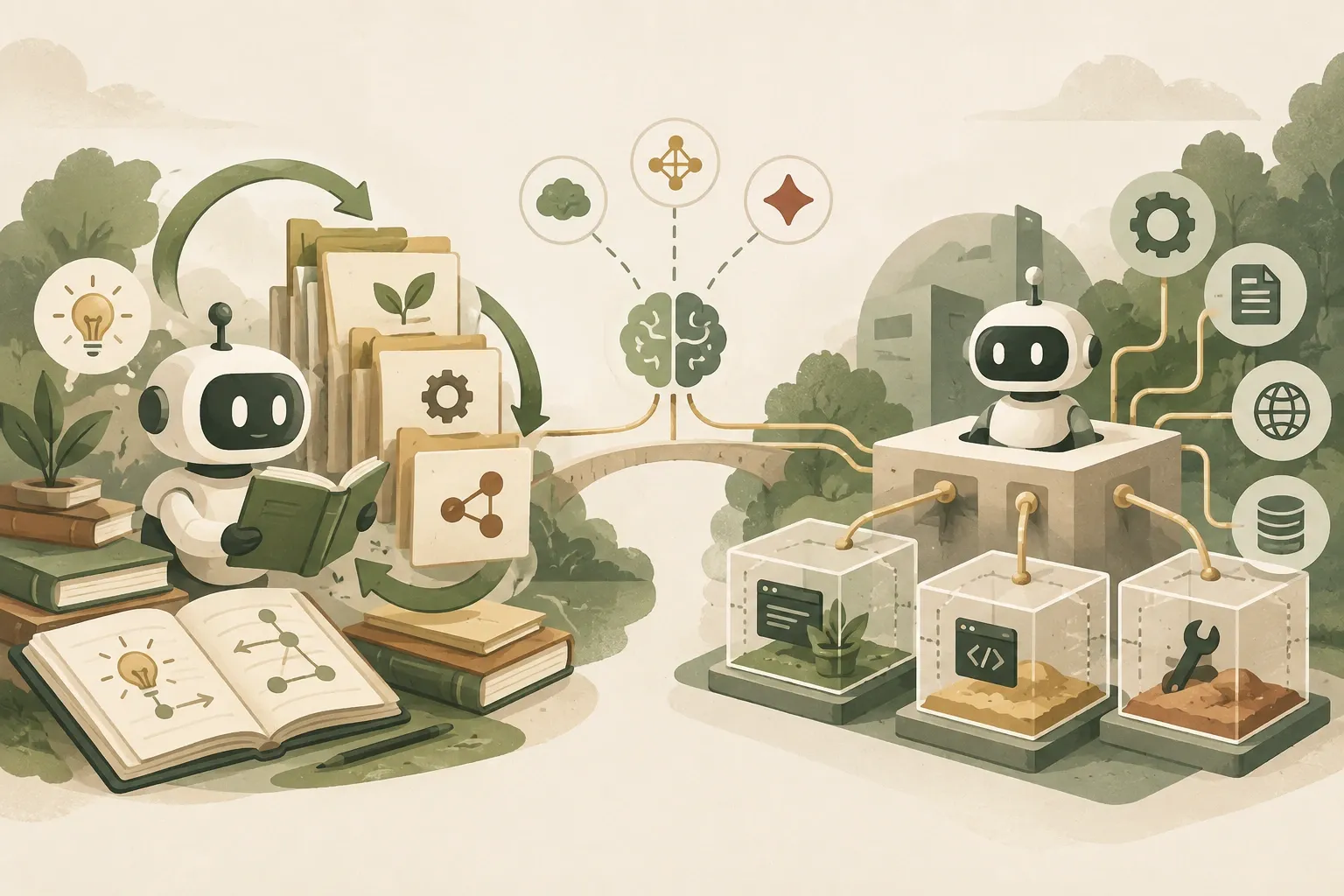
The briefest summary: both are agents, but their design centers differ
Hermes Agent and OpenClaw share open-source code, multiple model providers, chat channels, file and command tools, memory, skills, scheduling, and extensions. Compare the primary problem each architecture is designed to solve.
Hermes Agent centers on the idea of an “agent that improves through use.” The system separates Memory for important facts from Skills for workflows and lets the agent create or adjust Skills directly from experience. It also offers past-conversation search and external Memory Provider options for deeper long-term memory.
OpenClaw centers on the idea of an assistant on our devices and channels, with a Gateway as the control plane. Its strengths lie in separating Agent, Workspace, State, and Session; binding agents to accounts or channels; and configuring system-level policies, sandboxes, and tool permissions.
Hermes and OpenClaw at a glance
| Issue | Hermes Agent | OpenClaw |
|---|---|---|
| Core | Self-improving agent and the Memory → Skills → reuse cycle | Gateway + isolated agents + policy-controlled execution |
| Basic Memory | MEMORY.md + USER.md with size limit and session search | USER.md, MEMORY.md, daily memory files, DREAMS.md, and memory index |
| Skills | Agents can create and modify Skills themselves as direct procedural memory | Skill is an instruction package with precedence, gating and workshop/proposal flow. |
| Multi-agent | Profiles/Bot Mode + delegated subagents | Multiple agents in one Gateway, with separate workspaces/state/sessions and routing through bindings |
| Security framing | Defense in depth, with the key boundary still based on OS/container isolation | View the model as an untrusted principal and separate the trusted gateway from execution that can be moved to a sandbox. |
| Sandbox | There are many backends like Docker, SSH, Modal, Singularity, etc. | Tool execution can move into a sandbox, but sandboxing is disabled by default |
| Model | Separate the main model from auxiliary models serving different roles | provider/model, fallback, provider plugins and policy per Agent |
| Typical use cases | Agents that need to learn repeated tasks and accumulate working methods | Personal/team assistant who needs to route multiple channels and control rights systematically. |
1. Architecture: Hermes starts with the “Agent loop” and OpenClaw starts with the “Gateway”.
An easy way to think about Hermes Agent is as an agent runtime with memory, skills, delegation, and a gateway gradually added around it. OpenClaw instead treats the Gateway as the hub that receives messages, routes them, selects agents, manages state, and sends work to an execution environment under the configured policies.
Hermes supports local machines, containers, SSH, and various remote or serverless backends. The same agent core can move to an appropriate environment: local for file work, or sandbox/cloud to isolate work from the main machine.
OpenClaw separates “gateway” from “execution” more clearly conceptually. Gateway functions as a control plane and remains on the host, while execution tools can be sandboxed when launched. This approach makes thinking about permissions, routing, and agent boundaries part of the architecture from the beginning.
It is important not to interpret OpenClaw as “automatically secure” because the documentation clearly states that the sandbox is off by default and that the gateway and paired nodes are still in the same operator's trust zone. Therefore, actual security depends on configuration Not a feature name
2. Memory: Hermes emphasizes “curated memory,” while OpenClaw emphasizes “multiple memory layers”
Hermes uses two basic memory files: MEMORY.md for facts about the environment, projects, and what the agent learns, and USER.md for user preferences and communication style. Both are injected into the system prompt at session start and have size limits to encourage the agent to retain only important information.
For details beyond curated Memory, Hermes uses session search to store and retrieve past conversations as needed. This separates always-needed knowledge from information worth revisiting and avoids unnecessarily large initial context.
Another layer is external Memory Providers. Hermes supports providers for semantic search, knowledge graphs, user modeling, and cross-session summaries. They complement built-in memory rather than replacing it entirely.
OpenClaw uses a broader structure in the workspace, with USER.md, MEMORY.md, daily files in memory/YYYY-MM-DD.md and DREAMS.md for human inspection. The current Memory documentation also describes a built-in memory engine that indexes these files in a per-agent database and ranks retrieval by relevance, recency, and importance.
The architectural result is that Hermes tries to more tightly separate “facts that should be at the prompt” and “history that can be searched when needed.” OpenClaw is a memory workspace with long-term notes, daily working memory, and a retrieval index all in one system.
3. Skills: Where Hermes stands out most clearly
Hermes defines Skills as procedural memory, “knowing how,” versus Memory's factual knowledge. When agents solve multistep tasks, overcome dead ends, or receive user corrections, the system can save procedures as Skills for next time.
Hermes has tools for agents to create, update, or delete skills themselves, and write-approval for operators to choose whether to allow them automatically or to stage changes for review first. Here, self-improvement means adjusting procedural knowledge around the model through use, without changing the model’s weights.
OpenClaw also has a serious Skills system. Skills are folders that contain SKILL.md with metadata and can come from a workspace, agent, managed directory, workshop, bundled package or plugin. The system has clear precedence, allowlist, environment gating and sandbox synchronization.
OpenClaw treats Skills as part of the configuration and extension lifecycle rather than the heart of the learning loop. Even though there is a Skill Workshop and a process for agents to propose skills, the overall project does not tie the identity of the product to learning skills from every session as much as Hermes.
4. Multi-Agent: Hermes has “Bots + Delegation” while OpenClaw has “Agent Routing” as its main structure.
Distinguish two Hermes multi-agent approaches: delegated subagents split and parallelize subtasks, while Bot Mode uses persistent Hermes profiles. Each bot has its own role, model, memory, skills, credentials, and history.
Bot Mode supports specialist teams such as research, system-monitoring, and writing bots. Profiles genuinely separate state rather than merely renaming a persona prompt.
OpenClaw makes multi-agent routing a core Gateway primitive. Each agent has a separate workspace, state directory, model registry, and session store. It then uses bindings to bind incoming messages from channel/account to the correct Agent, for example, one Telegram account goes to a personal Agent, and a Slack workspace account goes to a corporate Agent.
In terms of control, OpenClaw also allows an agent to request the creation of another agent through the system's tools, but must receive operator approval first. This point is suitable for deployments that need to have multiple persona structures and want to know exactly where the state and credentials of each are.
Profiles and workspaces separate working state, but check whether agents share an OS user, readable folders, or credentials. Map each agent to its process, execution host, accessible folders, and accounts before judging whether either system isolates your data. This is KrobClick’s assessment method, not an isolation test of the two projects.
5. Models: neither is tied to one provider, but they handle supporting tasks differently
Hermes clearly separates the main model from auxiliary models. The main model is responsible for conversations and tool-call loops. For side tasks such as context compression, vision, webpage summarization, approval scoring, MCP routing, session naming, and skill search, different models can be selected.
This is useful when a strong model handles reasoning while smaller models perform supporting tasks, reducing cost or latency without weakening the main agent loop
OpenClaw references models in the form provider/model Supports many providers, including model fallback, provider plugins, custom endpoints, and policies that limit which agents can choose which models. The focus is on making the model catalog and routing part of the controllable configuration
If an organization wants “one agent using one core model and another utility model,” they can do this in different ways, but Hermes makes auxiliary model slots more of a product-level concept, while OpenClaw makes provider/model policy and fallback more central.
6. Tools and extensibility: Hermes emphasizes MCP and built-ins, while OpenClaw emphasizes its plugin and skill ecosystem
Hermes includes a tool registry covering web, browser, terminal, files, memory, delegation, and scheduled tasks, with MCP adapters connecting external systems without changing the core agent
OpenClaw has a plugin SDK and a Skill/Plugin system that connects directly to the Gateway and Agent. Plugins can add new providers, tools, or capabilities, and Skills from the Plugin are integrated into the system. using the same precedence and gating rules as other skills.
The practical difference is that if a team already has MCP servers, Hermes provides a very straightforward mental model: original Agent + additional MCP tools, while OpenClaw is suitable for cases where an extension is required to be deeply tied to the Gateway lifecycle, provider and agent policies.
7. Security: compare more than the word “Sandbox”
Security is the part where you must read the most detailed documentation. Because both systems can execute commands, read files, and hold credentials, the risk is higher than with a simple chatbot.
Hermes layers caller authorization, dangerous-command approval, file-write denylists, secret redaction, container isolation, MCP environment filtering, context-file scanning, and cross-session isolation. Its security policy says adversarial LLM scenarios still rely mainly on operating-system isolation. Prompt rules and heuristic approval are not boundaries as strong as container/OS isolation.
OpenClaw identifies the model/agent as not the trusted principal and provides security boundaries from host/config trust, authentication, tool policy, sandbox, and exec approvals. The "Why OpenClaw" document describes separating the trusted gateway from execution that can be moved to the sandbox, and outlines a deterministic policy that is enforced in code rather than asking the model to "obey prompts."
OpenClaw also has limitations: sandboxing is off by default; plugins run in-process as trusted code; paired Gateway nodes receive operator-scoped privileges. For mutually untrusted users, documentation recommends separating Gateway, OS user, or host by trust boundary rather than relying only on separate workspaces.
So a better question than “Which one has a sandbox?” is “Is the sandbox enabled? Who holds the credentials? How is tool policy enforced? What level of permissions do plugins have? And on which process/OS is untrusted input sent?”
8. Deployment: Hermes is a portable agent, while OpenClaw is an assistant centered on a Gateway
Hermes supports multiple execution backends, including local, Docker, SSH, and serverless/persistent cloud environments. One agent can run close to its work while retaining memory, skills, and gateway/channel access.
OpenClaw starts with an assistant “on your devices and in your channels.” A Gateway can serve personal or shared deployments; agent routing supports multiple personas/workspaces under one control plane.
To summarize the mental model: Hermes is like a “agent runtime that can learn and move execution across multiple locations,” while OpenClaw is like a “personal/team agent operating layer that centrally manages channels, state, agents, and execution policy.”
9. Everyday use: Different experiences despite similar instructions
With continued Hermes use, watch how agents accumulate successful procedures, such as deployment steps, project file formats, or system-specific fixes, then reuse Skills for similar tasks. Pay attention to Memory/Skill quality and enable approval if procedural knowledge should not change without review.
For ongoing OpenClaw use, align agents, bindings, workspaces, and permissions with context. Personal agents might access Home/Calendar, while public-group agents need restricted tool profiles and separate sandboxes. Topology design matters alongside model quality.
10. Cost and performance: An agent framework does not eliminate inference costs
Both Hermes and OpenClaw are harnessed around the model, so the main overhead also comes from the model, tool calls, browser/search services, storage, and execution environment chosen. Memory or multi-agent capabilities may reduce rework, but they may also increase the number of inference calls.
Hermes has the cost control advantage of splitting the main model with auxiliary model slots, making it easy for secondary work to use smaller models. OpenClaw has fallback and model policies that help define provider/model per agent and handle provider failure or unavailability.
Multi-agent work is not free parallelism: every subagent or specialist lane can increase token and tool use. Add agents only when separate context or parallel execution genuinely justifies it.
Controlled comparison plan: summarize one public changelog with comparable models and permissions. Measure actual-change coverage, citations, and model/tool calls. Test no-change and injection variants, checking for fabricated news or out-of-scope actions. Separate runtime effects from model/prompt changes. This is a hypothetical plan, not KrobClick measurements.
11. Choose Hermes or OpenClaw for your workload
- Need an agent that learns workflow iteratively: Hermes has a structure that fits this problem very well because Memory and Skills are designed as knowledge accumulation circuits where agents can write procedural knowledge back into the system.
- Need multiple personas that separate state and routes from multiple channels: OpenClaw centers agent routing, bindings, workspaces, and state directories, making its architecture a clearer fit for this requirement.
- Requires multiple types of cloud/remote execution: Hermes has several terminal backend types and explains how to move execution to remote/serverless deployments.
- Required policy/security topology for shared deployment: OpenClaw has detailed documentation on Gateway, sandbox, tool policy, and trust boundaries, but they must be enabled and configured as needed. You should not rely on defaults alone.
- To use existing MCP ecosystem: Hermes has MCP as a clear extension path that works with native tools.
- Requires a Plugin/Skill ecosystem tied to Gateway: OpenClaw has a detailed plugin, skill precedence, and gating system, suitable for managing multiple extension sources.
12. Common misunderstandings when comparing two projects.
“Hermes works only with Hermes models” Incorrect. Hermes Agent is an agent framework separate from the Hermes model family and supports multiple providers, including user-defined endpoints.
“OpenClaw is just a WhatsApp/Telegram bot” Does not match the current architecture. Channels are Gateway entry/exit paths, with separate agent runtime, tools, memory, plugins, multi-agent routing, and sandboxing beyond adapters.
“Self-improving means the model continually trains itself” In Hermes, this mainly means improving systems around the model, such as memory, skills, and knowledge reuse, rather than fine-tuning LLM weights after every conversation.
“Enabling a sandbox makes everything safe” That claim is incorrect. Sandboxing limits potential damage, but mounts, credentials, network access, plugins, user authorization, and trust boundaries still matter.
13. Can the two concepts be used together?
The systems' strengths suggest complementary design principles without requiring both frameworks. Hermes teams can borrow OpenClaw's trust boundaries and isolated untrusted execution; OpenClaw teams can borrow Hermes's distinction between factual memory and procedural knowledge and review learning before reuse.
Before choosing a framework, answer 5 questions: what does the agent remember and where, what can it learn by itself, who approves state changes, which tools run on the real host, and which boundary can contain the effects of prompt injection?
Conclusion: Hermes focuses on “improving through experience,” while OpenClaw focuses on “controlling agents across contexts through a Gateway.”
Hermes Agent and OpenClaw belong to the same broad category: open-source agent harnesses working with tools, filesystems, and communication channels. Their designs differ: Hermes emphasizes learning loops, persistent memory, agent-managed skills, and multiple execution backends; OpenClaw emphasizes Gateway routing, agent isolation, provider/plugin configuration, and execution policies.
For systematic comparison, test both systems on the same 3–5 workflows, such as long research, file editing, scheduled work, Telegram/Slack tasks, and credential use. Measure prompt revisions, knowledge reuse, token/tool costs, and potential harm from wrong decisions. Real workflows reveal more than README feature lists.
Sources
- Nous Research: Hermes Agent Documentation
- Nous Research: Hermes Agent Persistent Memory
- Nous Research: Hermes Agent Skills System
- Nous Research: Hermes Agent Security
- Nous Research: Hermes Agent Configuring Models
- Nous Research: Hermes Agent Bot Mode
- OpenClaw: Why OpenClaw
- OpenClaw: Memory Overview
- OpenClaw: Multi-agent Routing
- OpenClaw: Sandboxing
- OpenClaw: Skills
- OpenClaw: Model Providers
- OpenClaw: Security Policy
Project documentation reviewed October 2, 2026. Features, defaults, commands, and architecture change quickly; check actual-version documentation before configuring critical systems.