
Credentio and C2PA: Verify Provenance, Not Content Truth
Credentio is Google’s open-source library for checking C2PA Content Credentials locally. This data helps trace the origin and editing history of images, audio, or video. Provenance checks still need to be distinguished from verification of the content itself.
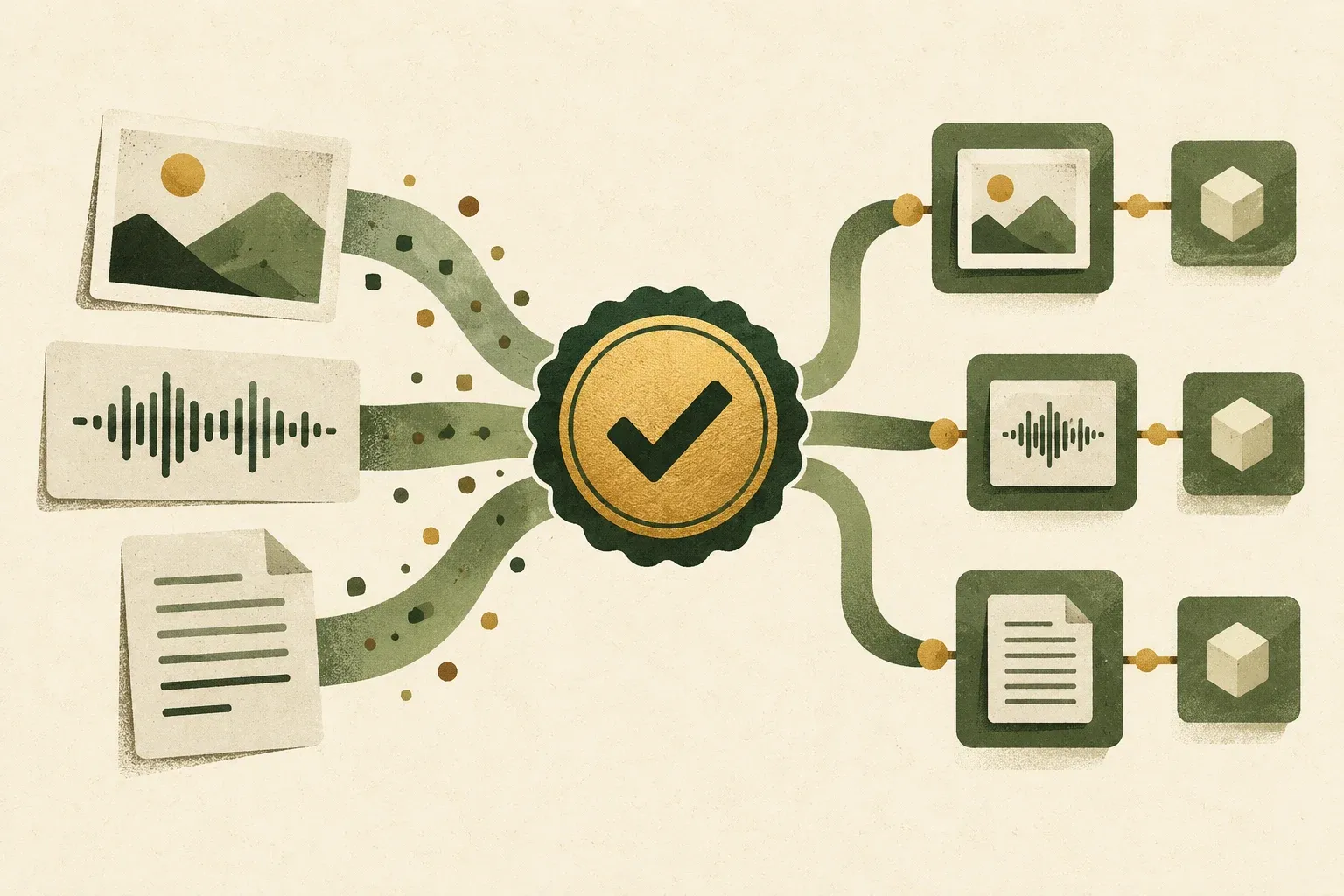
C2PA Content Credentials are provenance information attached to digital media
C2PA records content provenance: who or which device created a file, subsequent edits, and whether that information was later altered. A digitally signed manifest lets software check integrity and the chain of trust.
Unlike fake-image detectors guessing from pixels, C2PA checks evidence recorded by creators or tools rather than whether an image “looks AI-generated”
Credentio is a C++ library for local credential verification
Google launched Credentio as an open-source project for reading and verifying C2PA Content Credentials, initially supporting specification versions 2.2 and 2.4. Google says the same code serves multiple C2PA-enabled products and processes many digital assets.
The August 2026 launch announcement focuses on reading manifests, assertions, claims, and signatures and reporting successful or problematic verification, but README additionally reviewed on October 18, 2026 now lists both validation and generation, a format-support table, and writer links. Credential generation is therefore no longer merely a future plan in that source version. Source support does not establish that a particular build or app is ready; check the version and test real files separately.
| File format | Validate C2PA data | Generate C2PA data |
|---|---|---|
| JPEG | Supported | Supported |
| PNG | Supported | Supported |
| MP4 | Supported | Supported |
| fragmented MP4 | Not supported | Not supported |
| RIFF, such as WebP and WAV | Supported | Supported |
Local checks help with privacy and large files.
- No need to send files off-device: Apps can inspect media on-device or on their own servers, reducing exposure to external destinations
- Reduce time and bandwidth: especially very large videos or high-resolution images
- Works in several environments: From desktop and mobile apps to server-side or edge pipeline
- You can define a trust list: Developers can use official or organization-customized lists to evaluate signers.
A verified credential does not necessarily mean that every word of the content is true.
A valid signature helps confirm that a manifest comes from a signer under a trusted certificate and has not been altered without detection. It cannot guarantee that the depicted event actually happened, that the caption is accurate, or that the creator has no intent to deceive.
A file without Content Credentials is not necessarily fake. The camera or software may lack support, information may be stripped during sharing, or a platform may convert the file and lose the manifest.
Hypothetically, file A passes signature/provenance checks but carries a false event caption. File B lacks Content Credentials but has other event evidence. A's result does not validate the caption, and B's absence does not prove a fake. Record verified integrity and signer information separately, then inspect content/context elsewhere. This is not an actual Credentio test.
Explain verification results and remaining uncertainty
Valid, unknown issuer, tampered, and missing credential mean different things. UI should explain findings and remaining uncertainty instead of simply true/fake labels, with provenance, dates, and editing steps available when needed.
Administrators still need to update trust lists, handle revoked certificates, and test multiple file formats. Local verification reduces data transmission but does not remove maintenance of the trust system.
Use C2PA data as part of fact-checking
Credentio enables local-first provenance checks, useful for large or confidential files. Results remain one piece of evidence alongside source, context, and plausibility checks. Good design shows who attests to what and what remains unverified, rather than only a credential pass/fail.
Sources
- Google Developers Blog: Introducing Credentio
- Coalition for Content Provenance and Authenticity
- Google / Credentio contributors
References the original launch announcement and additionally checks the source README at commit cdc4101b6fd26415a461f3de38f7b64ea995714e on October 18, 2026, without installing or testing the library. Standards and trust lists may change. Credential verification alone does not prove content is true.