
AI Investment and Energy: Follow the Costs and Cash Flow
AI growth does not mean every related company will become more profitable or every stock will deliver good returns. Before investing in a narrative, distinguish who earns revenue, who pays construction costs, who bears risks, and what expectations prices already reflect.
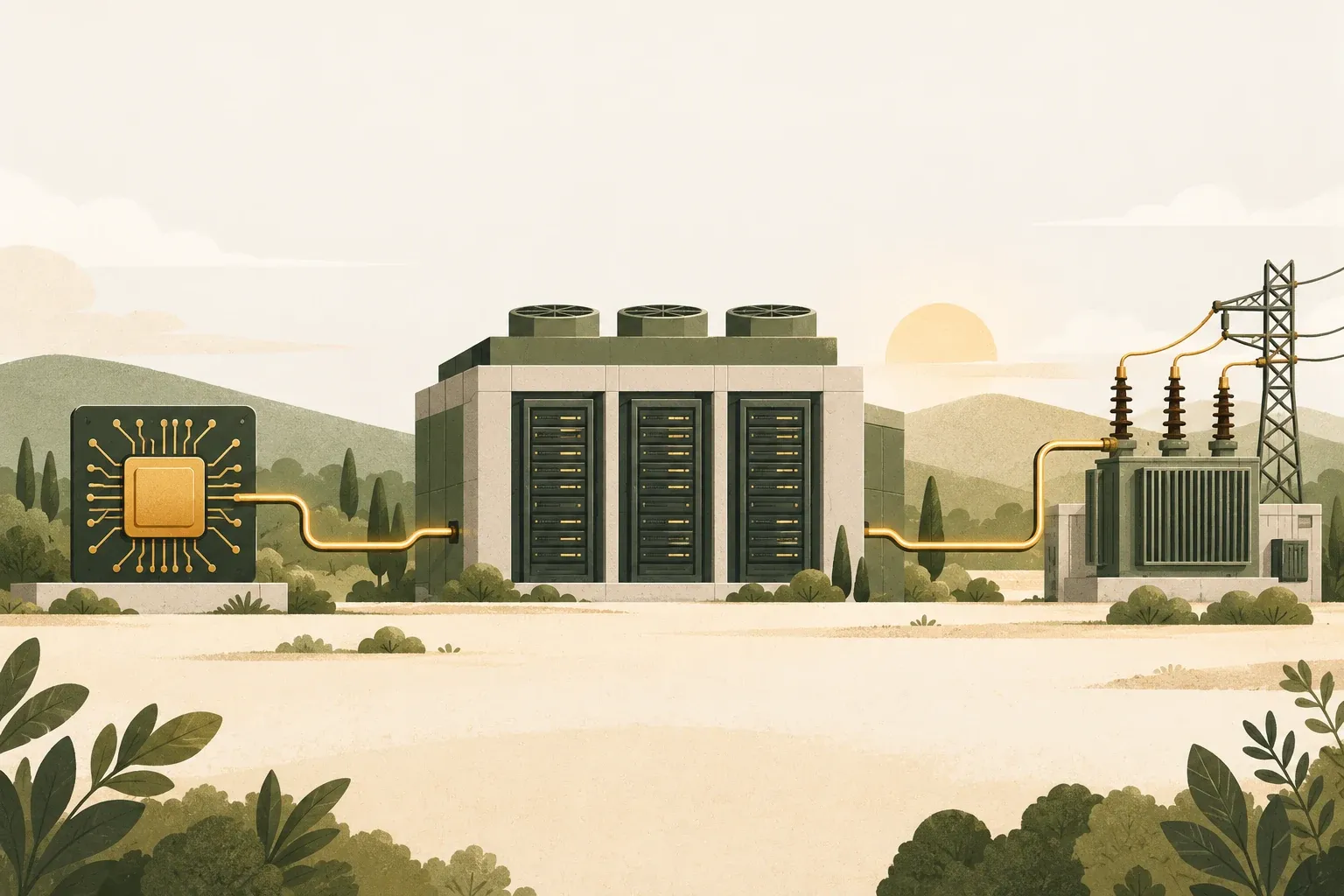
Start with money flows instead of labeling every company an AI stock
AI services rely on chips, memory, networks, servers, data-center buildings, power, cooling, and software customers pay for. Each business layer sells different products, requires different capital, and benefits on different timelines.
The framework below is KrobClick's explanatory grouping, not a recommended securities list. A company may span layers, such as owning data centers and selling cloud services. Read segment reports and do not label all revenue as AI revenue unless the company discloses it that way.
| Business layer | Products sold or services provided | Questions to check |
|---|---|---|
| Chips and devices | Processing power, memory, network | Are customers concentrated? How firm are orders? Do new products quickly reduce demand for older models? |
| Data Center and Cloud | Space, infrastructure availability, and computing capacity | When will electricity be ready, how many actual tenants or users exist, and how long must investment precede revenue? |
| Electricity and supporting systems | Electricity, transformers, transmission, cooling | Are there actual contracts and connection points? Who bears the additional costs and delays? |
| Models and applications | Access to models and results | Will customers keep paying? Does the price cover usage costs? |
Read IEA figures with their year, baseline, and scope
IEA's Key Questions on Energy and AI report 2026 Global data-center electricity use is projected to rise from 485 TWh in 2025 to roughly 950 TWh in 2030, around 3% of global demand that year. TWh measures energy, unlike GW installed capacity. Figures cover all data centers, not AI alone.
Meanwhile, Year report 2025 previously projected a base case of roughly 945 TWh in 2030. When using the latest data, identify the 2026 edition and do not combine different baseline years into one series without explanation. Both editions contain conditional forecasts, not electricity consumption already recorded in 2030.
The IEA's 2026 report also identifies grid-connection, equipment, and financing constraints, with no basis to conclude AI benefits every energy company equally. Check individual projects and contracts before translating global trends into company revenue forecasts.
Why can revenue grow while cash remains tight?
Building a data center or purchasing equipment requires money first. Capital expenditures, or Capex, are thus the link between the growth narrative and cash accordingly. SEC guidance on reading reports Read financial statements and management commentary to understand investment and risks, not sales alone
Hypothetical example of KrobClick: Hypothetical Company A has revenue of 1,000 million baht, CFO of 300 million, and fixed-asset spending of 500 million. Simplified FCF is 300 − 500 = −200 million baht. Use spending as a positive input. These are not actual company financial statements.
Starting with 250 million baht and no other cash flows would leave 50 million after these items. Actual statements also include borrowing, share issuance, repayments, dividends, and other items. Negative FCF alone cannot establish bankruptcy. Conversely, borrowing that raises ending cash does not establish stronger business cash generation.
Negative FCF may occur while investing for growth. Ask when projects will generate cash, whether customer demand exists, and how much delay the company can withstand. Read more in FCF vs. EPS and P/E and Cash flow statement for three activities
From announcement to revenue: check each step
- Plan versus contract: Check whether the company is assessing feasibility, signing preliminary terms, or bound by contract. Do not call the whole project budget revenue.
- Site readiness: Are land rights, permits, electricity, and equipment ready? The opening date may differ from the announcement date.
- Income conditions: Charge according to actual usage or reserved capacity. Who takes the risk if customers use less than the plan? And are there any cancellation conditions?
- Lifetime cost: Includes energy costs, maintenance, equipment replacement, interest, and depreciation. Don't just look at initial construction costs.
- Cash collection ability: Do customers pay on time, or do they face funding risks? A growing balance from one large customer may increase revenue concentration.
Apply the same questions to Thai companies linked to data centers, using their own revenue disclosures and project documents. Operating in a related industry or signing a memorandum of understanding does not establish how much profit will follow.
Test less favorable scenarios before relying on one growth forecast
Compare three scenarios: on-time launch, delayed launch, and lower-than-planned utilization. Ask when revenue begins, which expenses continue, and whether more funding is needed. Mark unknown contract terms as unknown rather than completing the model with invented figures.
Hypothetical example: If revenue begins 6 months late while fixed cash costs are 10 million baht monthly, the waiting-period burden is 6 × 10 = 60 million baht, assuming unchanged costs and no offsetting revenue. Interest and penalties are excluded. This teaches cash-flow timing, not an actual project forecast.
Even a favorable base case requires checking prices and portfolio risk. Multiple companies depending on the same customers' investment budgets diversify names more than underlying risks. Read A guide to avoiding repeated risks in your portfolio
Check revenue, profit, and cash flow when evaluating an AI business
Combining the two examples as an exercise, the hypothetical company has 50 million baht cash after investment but must pay another 60 million while waiting for income: a 10-million shortfall if no other inflows or outflows occur. This is an additional hypothetical scenario, not an IEA estimate or real project. Check which debts and obligations the 50 million must also cover before applying it to a company.
A useful review path is AI trend → revenue the company can earn → costs and investment → cash and risks → price paid. Leave gaps in evidence as open questions. Rising AI demand does not guarantee returns for any company or stock. This article is general education, not personalized investment advice.
Sources
- IEA: Key Questions on Energy and AI — Executive summary (2026)
- IEA: Energy and AI — Energy demand from AI (2025)
- SEC Investor.gov: How to Read a 10-K/10-Q
Primary sources checked on October 13, 2026 (Thailand time). Recommendations and examples are KrobClick's own, not AI test results or actual investment returns. This article is educational, is not personalized financial, investment, legal, or tax advice, and does not guarantee returns.