
Project Suncatcher: Google’s Orbital AI Research
AI data centers need substantial electricity, cooling, and networking. Google is therefore testing a seemingly distant question: could some computing move into space? Project Suncatcher is not yet a commercial data center; it is a series of experiments addressing fundamental questions one at a time.
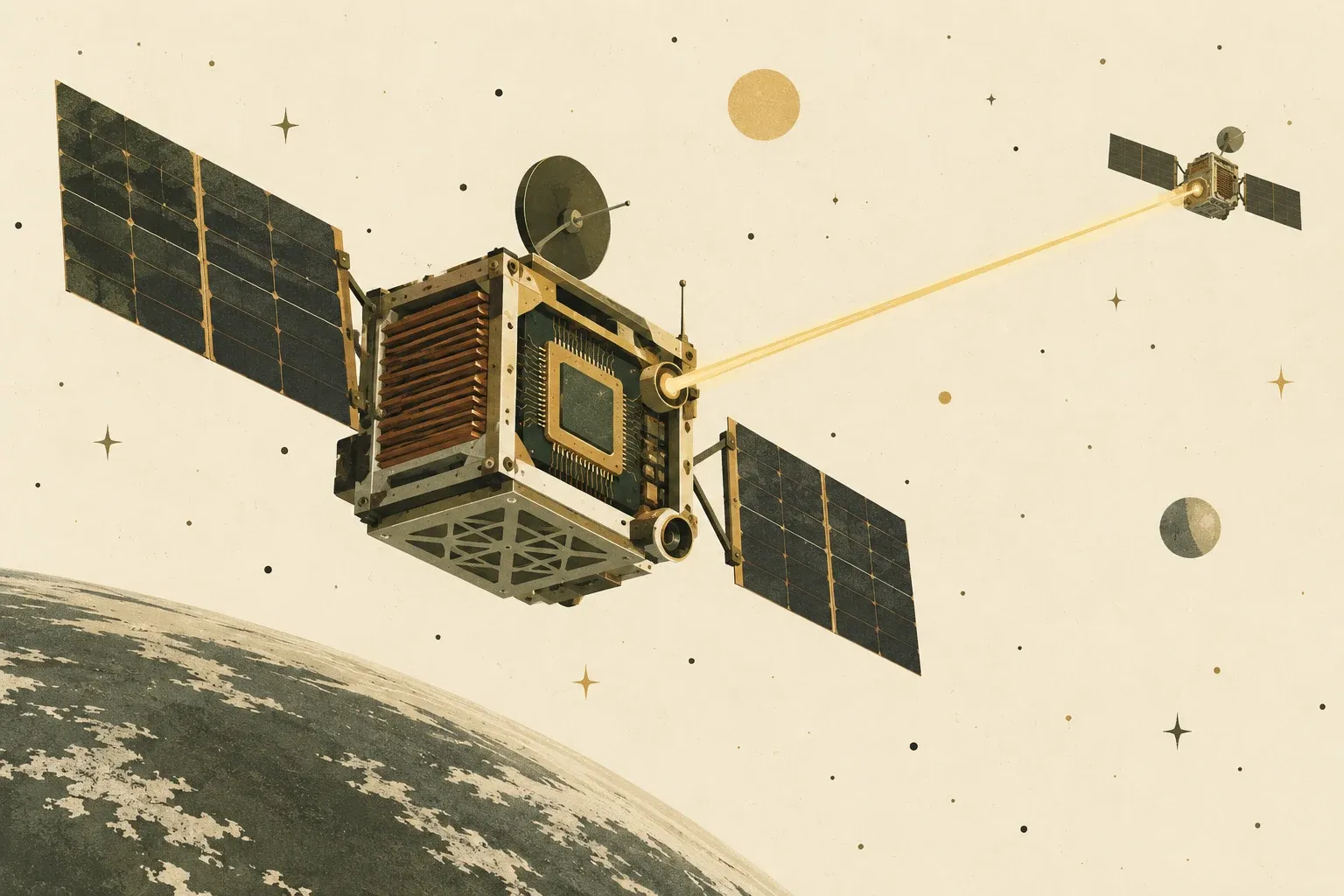
Project Suncatcher is an orbital AI infrastructure experiment.
Project Suncatcher is Google’s long-term research into scalable machine-learning infrastructure in space. The proposed system is a constellation of solar-powered satellites carrying Tensor Processing Units (TPUs), connected by high-speed optical links.
The October 1, 2026 announcement reports one prototype satellite, built with Planet, launched aboard Transporter-18. The team confirmed contact and planned further in-orbit TPU data collection. Contact with one satellite does not establish optical communication between multiple satellites or an operational data center.
A reason to look toward space is more continuous sunlight
Google says satellites in low orbit can receive near-continuous sunlight and may generate several times more solar energy than panels at some locations on Earth. This is relevant to the energy demands of large-scale AI.
Available energy does not immediately make the system economical. Count energy and resources for manufacturing, launches, orbit control, communications, equipment replacement, and end-of-life management. The project must prove the whole-system equation, not merely panel energy received in space.
Hardware must withstand vibration, radiation, and temperature changes
- Launch forces: The craft experiences high vibrations and acceleration. Some components may be subject to greater forces than the satellite itself.
- Radiation: High-energy particles can flip data bits or damage circuits, requiring tests of durability and workload effects
- Vacuum and heat: There is no air to carry chip heat away; designs must rely on heat pipes and radiators
Google reports ground tests show that its Trillium TPU chip withstood a total radiation dose greater than expected during a five-year mission. But laboratory tests cannot simulate all real-life situations. Data from satellites in orbit is therefore the next important step.
Connecting multiple satellites is as difficult a problem as the chip itself.
Large AI workloads need high-bandwidth processor links. TPUs spread across satellites require accurate relative positioning and beam aiming while all satellites move. Google compares it to targeting a coin from miles away while both sides move.
The 2027 plan is to test two satellites to study this kind of link. Before discussing large constellations, questions remain about latency, error correction, scheduling, and continued operation when some satellites fail.
What not to conclude from the first trial
Contact with a satellite and confirmation that its chip operates in orbit show that a prototype can begin collecting data. They do not prove that orbital data centers are cheaper, cleaner, or easier to maintain than terrestrial facilities. Debris, service life, repairs, international rules, and data transmission to Earth still need assessment.
Follow Project Suncatcher as feasibility research. Its long-term goals help define the experiments, but conclusions still require data from several missions and transparent assessment of the system’s life cycle.
For the next news story, keep three evidence columns: ground component tests, satellite operation, and continuous multi-satellite system results. If it confirms only a prototype in orbit, record only that; do not add claims that data-center costs or all satellite links are proven. This is KrobClick's evidence-reading framework, not new experimental results from the project.
Knowledge from the experiments may inform systems on Earth
Even if space-based AI computing remains distant, lessons in energy-efficient chips, cooling, optical links, and fault-tolerant systems may benefit Earth. The project starts with a smaller, measurable question rather than a huge constellation: can AI hardware survive and actually operate?
Sources
- Google Blog: Behind Project Suncatcher, our moonshot to put AI in space
- Google Blog: Our Project Suncatcher prototype satellite is in orbit
- Google Research / Travis Beals
- Google guidance
This article uses experimental information reported by Google as of 7 October 2026. The project remains in research. Conclusions about costs, energy, reliability, and environmental impacts require more evidence. This article provides general information.