
Invoice amount differs from the bank deposit: fees, partial payments and discounts
A 970 deposit against a 1,000 invoice does not prove the customer owes 30: a payment provider may have deducted a fee, or there may be an agreed discount. Check the evidence first.
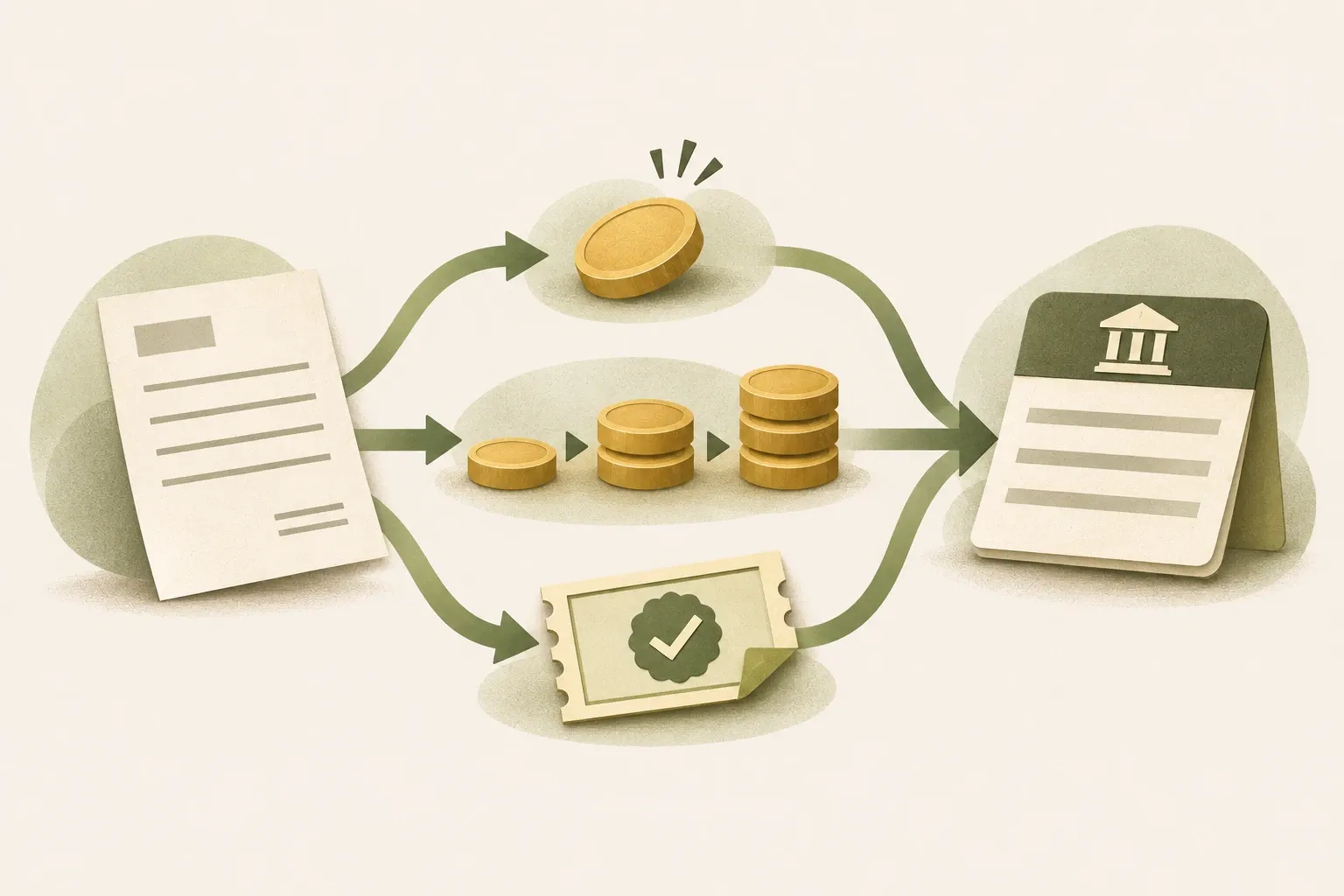
Separate what the customer paid, what was deducted and what reached the bank
If the deposit is smaller than the invoice, do not write off the debt or request another payment yet. Separate the invoice balance, the customer’s gross payment where documented, the provider’s deductions, and the net bank deposit. A difference that resembles a familiar fee rate is not proof. Check the customer’s payment notice, the provider’s report, and the invoice terms together.
The customer may have paid in full while the provider transferred only the net amount. Or the customer may have paid part of the bill, leaving a balance unless a credit note or documented agreement says otherwise. Those cases call for different follow-up. This is a way to examine evidence, not a universal accounting rule.
A net payout does not always mean the customer underpaid
Suppose a 1,000.00 USD invoice is backed by a provider report showing that the customer paid 1,000.00 USD for it. The provider deducted a 30.00 USD processing fee and deposited 970.00 USD: 1,000.00 − 30.00 = 970.00 USD. If the actual report supports this and the business’s accounting method permits it, the customer’s invoice may be settled while the fee is recorded separately. Do not demand another 30.00 USD merely because the bank shows the net payment.
A single 970.00 USD bank row cannot tell you whether it represents one sale. It could combine several payments, reflect a refund or reserve adjustment, or belong to another customer. Stripe's payout reconciliation documentation explains how Stripe payouts relate to underlying transactions. Where available, use the actual report from your own provider rather than inferring its deduction rules from a bank CSV. KrobClick does not retrieve those reports.
A partial customer payment leaves a balance
In another hypothetical case, a customer transfers 400.00 USD toward a 1,000.00 USD invoice. The bank confirms 400.00 USD with that invoice reference. With no other receipts or adjustments, 600.00 USD remains due. Keep the original invoice, record the 400.00 USD receipt once, and track the remaining 600.00 USD. A promise to pay later is not a bank receipt. Have an accountant check how to record both amounts in the business’s system; KrobClick does not post them.
For a transfer covering several invoices, ask how much goes to each and reconcile the gross total against the evidence. Do not allocate it to the oldest invoice by habit when the breakdown is missing. If a transfer is reversed or refunded, review whether the receipt must be reversed under the business’s procedures.
An agreed discount needs terms and evidence
Suppose a 1,000.00 USD invoice offers a 20.00 USD early-payment discount. The customer qualifies, transfers 980.00 USD directly, and no intermediary fee applies. The 980.00 USD receipt plus an approved 20.00 USD discount settles 1,000.00 USD. Keep the terms, payment date, and approval. Without that evidence, the 20.00 USD difference needs investigation or remains due; do not invent a retroactive discount to close it.
A discount can affect reporting and tax, and early-payment terms vary by contract and country. Ask an accountant or qualified adviser how to adjust the real transaction and its tax treatment. The hypothetical amounts above are not a general posting rule.
Use evidence, not the size of the difference, to identify its cause
| Observed amounts (USD) | Evidence to request | Status during review |
|---|---|---|
| Invoice 1,000; net payout 970 | Gross customer payment and fees in provider report; payout ID | Possible fee deduction; full payment not yet confirmed |
| Invoice 1,000; direct deposit 400 | Payment advice, bank reference, earlier receipts | Possible partial payment of 400; if confirmed, 600 remains due |
| Invoice 1,000; direct deposit 980 | Written discount terms, eligibility, customer confirmation | Possible discount of 20; without evidence, investigate the remaining 20 |
| One deposit covers two invoices | Customer's allocation details and both invoice balances | Await allocation pending verification |
The table uses hypothetical USD amounts without tax or currency conversion. Before calculating a difference, check the invoice and payment currencies. For a cross-currency payment, keep the pre-conversion amount in its original currency, the conversion rate and date, conversion charges, and the bank deposit in its final currency. Subtracting amounts in different currencies directly tells you nothing.
Keep unexplained differences open for review
When the cause is unclear, record the invoice number, payout code or bank row, suspected cause, missing evidence, person following up, and next review date. Do not quietly net a fee against sales, edit the bank row, close the invoice, or post the difference anywhere convenient. Bank reconciliation compares the bank with the business ledger and investigates discrepancies. AccountingCoach distinguishes timing differences on the bank side from items such as verified fees that may require a ledger adjustment.
If you have not identified which invoice a deposit belongs to, see how to match invoices against a bank CSV. If you need to check the entire cash account, see how to reconcile a small business bank account. Meanwhile, KrobClick's CSV Editor can open a CSV copy, but cannot decide whether a discount is authorized, post entries, or reconcile the bank for you. Restrict access to sensitive files and seek expert advice for disputes, material amounts, or jurisdiction-specific rules.
Sources
Hypothetical educational examples, not accounting or tax advice. Discounts, taxes, exchange rates and fees must be handled according to the contract and local rules. KrobClick does not connect to banks or post accounting entries automatically.