
Cash Conversion Cycle: DSO, DIO, and DPO Explained
Sales can grow while cash remains tied up in receivables or inventory. The cash conversion cycle helps examine collection times, inventory holding periods, and supplier payments.
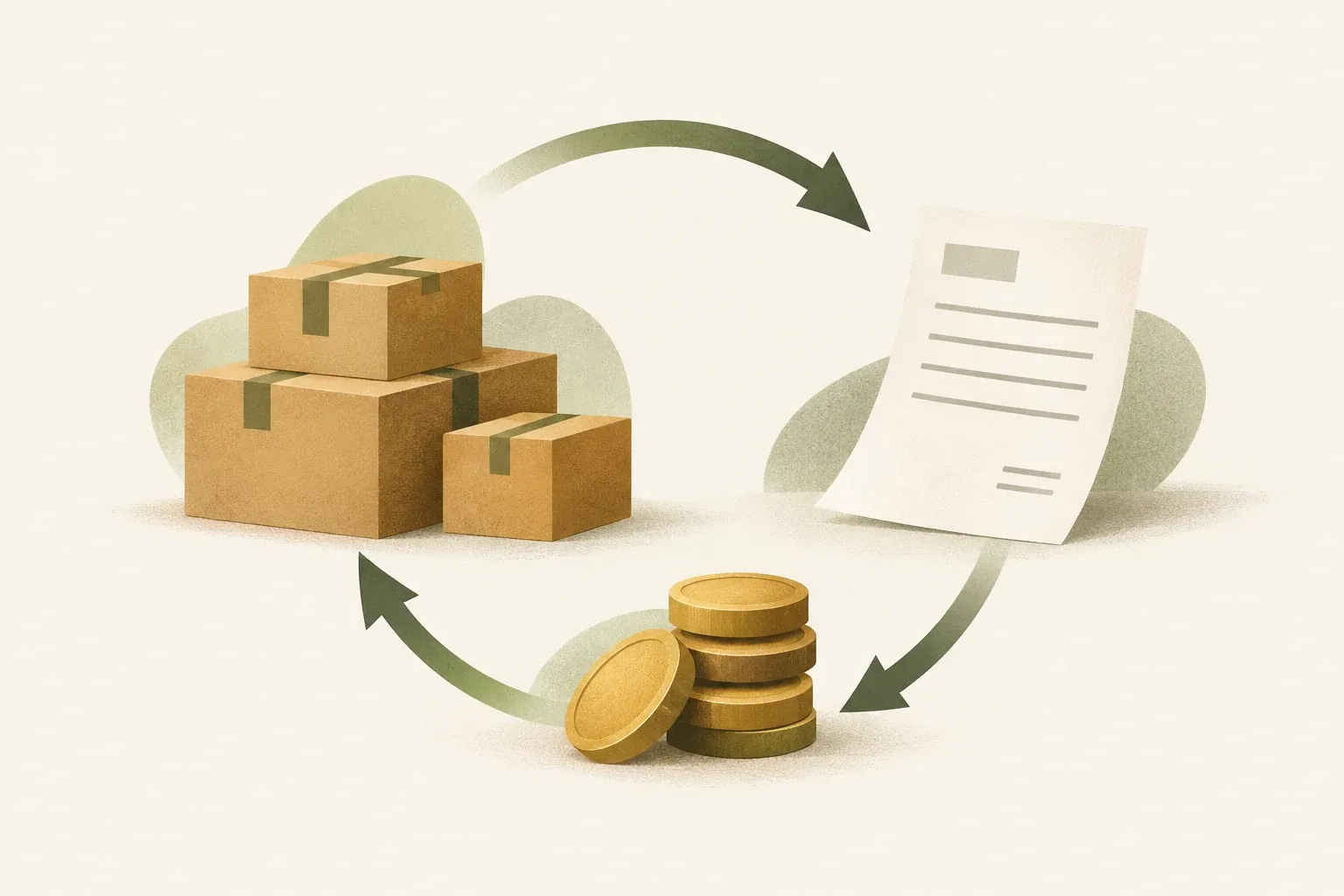
CCC measures the time between paying and collecting the money back.
Cash Conversion Cycle (CCC) = DSO + DIO − DPO DSO is days to collect receivables, DIO days inventory waits before sale, and DPO approximate days to pay suppliers. All are in days. Lower CCC often indicates less working capital tied up, but business models matter.
Example of CDW company in document Form 10-K filed with the SEC. Explains DSO, DIO, and DPO calculations using rolling three-month averages, showing that actual companies may use more detail than this article's simplified formulas
Calculate CCC from receivable, inventory, and payable days
| Variable | Approximate formula for a 365-day reporting period | Meaning |
|---|---|---|
| DSO | Average accounts receivable ÷ sales × 365 | Days sales outstanding |
| DIO | Average inventory ÷ cost of goods sold × 365 | Days inventory held |
| DPO | Average accounts payable ÷ cost of goods sold × 365 | Days payable outstanding |
The term “average” in this example means (beginning of the year + end of the year balance) ÷ 2 which may be inaccurate for businesses that are highly seasonal. Some companies use monthly or quarterly amounts to be more accurate. and credit sales should be selected instead of total sales when appropriate information is available.
DPO using cost of goods sold as the denominator is only an estimate: Where comparable credit-purchase data is available, consider using it for trade payables. Cost of goods sold measures goods sold, not necessarily goods purchased in the period; inventory buildup can make the two amounts differ greatly. Do not mix loans or other liabilities into trade payables.
For interim statements, use the period's day count with sales and cost of sales from that same period. Do not directly multiply 365 by a single quarter's revenue. If the denominator is zero or comparable data is unavailable, report that the calculation is unavailable instead of 0 days.
Hypothetical example: CCC approximately 48.67 days.
Suppose a wholesaler has annual sales of 36.5 million baht, cost of goods sold of 21.9 million baht, average receivables of 3.65 million baht, average inventory of 2.19 million baht, and average payables of 1.46 million baht. All amounts are in baht and are hypothetical data for a 365-day year.
- DSO = 3.65 ÷ 36.5 × 365 = 36.5 days
- DIO = 2.19 ÷ 21.9 × 365 = 36.5 days
- DPO = 1.46 ÷ 21.9 × 365 ≈ 24.33 days
- CCC = 36.5 + 36.5 − 24.33 ≈ 48.67 days
Under these assumptions, the business has a gap of about 49 days between paying out and receiving cash. This is an overall cycle measure; it does not mean every transaction takes that long or establish that the company will run short of cash.
Retain decimal precision during calculation and round only the final result to two places, giving 48.67 days. The displayed 24.33 above is rounded for readability. Rounding each value down to an integer before summing may hide small trends.
Let's change just one variable: If DSO rises from 36.5 to 46.5 days while DIO and DPO remain unchanged, CCC increases by 10 days to approximately 58.67 days. Average sales in this example are 100,000 baht per day, so the additional 1 million baht in average receivables explains the longer wait for cash. But do not multiply the entire CCC by sales and claim this is a definite borrowing requirement: DSO uses sales, whereas DIO and DPO use costs.
Negative CCC is not always good, and direct cross-industry comparisons can mislead
Collecting payment before delivery can produce a negative CCC, while manufacturers holding raw materials for long periods may have substantially positive CCCs. Increasing DPO reduces the calculated cycle, but overdue supplier payments that damage trading relationships are not necessarily a good sign.
Revenue-recognition changes, acquisitions, and seasonality can affect the figures. Compare similar businesses over several periods rather than judging business quality from CCC alone.
Use CCC alongside the cash flow statement and management commentary
Include a Missing Information field before calculating. Year-end receivables of 3.65 million baht without an opening balance do not establish an average of 3.65 million. If year-end balances proxy averages, disclose possible inaccuracies; do not claim equivalence with monthly-average calculations.
- Extract receivables, inventory, and payables from at least two period-end balance sheets
- Pull sales and cost of goods sold from the income statement for the same period. Check units and currency
- Calculate DSO DIO DPO and record average method and number of days.
- Read notes on collections and inventory, and compare with operating cash flow
This article is educational. It is not securities trading advice. And the examples don't refer to real companies.
Sources
SEC documentation reviewed October 16, 2026, Thailand time. Figures are hypothetical using a 365-day approximation, not CDW data.